What Is Insomnia, Really?
The Present: A "Sleep Crisis" Almost Nobody Escapes
Roughly one third of your entire life is spent in bed. Whether that time actually restores you — enough sleep, good sleep — decides how sharp you are the next day and what your health looks like years down the line. And yet this most basic of needs has quietly become a struggle for more and more people.
A few numbers show just how widespread it is. According to the China Sleep Big Data Report (2023), published by the China Sleep Research Society and partner institutions, 38.2% of Chinese adults meet the threshold for insomnia, and close to 510 million people live with some form of sleep disorder. This is no longer a private annoyance — it is a public-health problem at a staggering scale.
Today we spend more on wellness than any generation before us, yet sleep has become modern life's stubbornest knot. Sleep topics keep climbing the trending lists — "Should I try to fall back asleep after waking at 3 a.m.?" "Is it bad to force yourself to sleep?" People describe it in their own words: "I'm asleep but my whole night is one long dream, and I wake up like I've been beaten." Others say "my body is exhausted but my brain is wired," or "I don't want to go to bed at night, can't get up in the morning, my focus scatters, and my work just collapses."
Question 1: How Many People Are Actually Losing Sleep?
Start with the prevalence rates, and don't be fooled by the "nobody around me has insomnia" feeling:
- People who have ever shown insomnia symptoms: 30%–48%.
- Those at the frequency level of at least 3 nights a week: about 16%–21%.
- Those already showing daytime impairment (work, mood, daily life affected): 9%–15%.
In other words, from "occasionally tossing and turning" to "clearly dragged down by day," insomnia is a long spectrum, and almost everyone sits somewhere on it.
Question 2: Why Can't You Fall Asleep?
In 2025, a team led by Academician Lu Lin of Peking University Sixth Hospital published a review in The Lancet Public Health that mapped out sleep problems across the Chinese population. The key takeaway: the triggers of insomnia are never single. They hang off four threads at once — biological, lifestyle, social, and environmental.
Look one level deeper, and insomnia is usually described as three forces in conflict:
- Predisposing factors — the groundwork that makes you vulnerable in the first place: genetics (a family or identical-twin history roughly triples the risk), or a temperament that is naturally tense and fretful.
- Precipitating factors — a concrete stressor, most often pressure: a crunch at work, a fight, a job change.
- Perpetuating factors — this is the one that matters most and gets overlooked. When predisposition and precipitation collide, you get a bout of acute insomnia. If you then carry a stack of bad habits — a nightcap, a chaotic schedule, lying in bed awake scrolling your phone — the acute easily hardens into chronic. And the "fixes" people reach for after insomnia sets in (lying there grinding it out, checking the clock over and over) only nail the chronic state down tighter.
Question 3: Where Does Long-Term Insomnia Take You?
Insomnia is never just "tired tomorrow." It buries real hazards in the body and in daily life:
- Physical: higher risk of hypertension, heart failure, coronary heart disease, and stroke.
- Mental: raised probability of depression, anxiety, and post-traumatic stress disorder (PTSD).
- Public: drowsiness-driven errors at work, industrial accidents, traffic crashes, even elevated mortality — all real costs.
Question 4: How Do You Tell If You Have Insomnia?
First, sort out which kind you are:
- Chronic insomnia: it has lasted ≥3 months, with poor sleep ≥3 nights a week.
- Short-term insomnia: under 3 months, with no hard frequency requirement.
- Other insomnia: a mixed bag — restless legs syndrome, subjective insomnia (also called paradoxical insomnia), behavior-driven insufficient sleep syndrome, narcolepsy, and the natural "short sleepers" who need very little sleep (about 1% of people).
Then check yourself against this standard, point by point:
- Time gate: within 3 months, and all of the following show up ≥3 times a week.
- Symptom gate:
- At night (any one counts): taking ≥30 minutes to fall asleep, waking ≥2 times a night, or waking earlier than intended (typically between 2 and 5 a.m., or more than 30 minutes early).
- By day (any one counts): fatigue, sleepiness, scattered attention, irritability, constant worry about sleep — and it already clearly interferes with school, work, and daily living.
- Rule-out gate: first exclude a poor environment (uncomfortable bed, too much noise) and sleep trouble caused by another illness or medication.
PSQI: A "Full-Body Checkup" for Your Sleep
You can't judge sleep quality with a vague "I feel okay." The field's go-to tool, the Pittsburgh Sleep Quality Index (PSQI), scores sleep across 7 dimensions at once — it's like a full physical exam for your nights:
- Subjective sleep quality: your overall satisfaction with the night. Sounds subjective, but it directly reflects how heavily sleep problems weigh on you.
- Sleep latency: how long from lying down to actually sleeping. Most healthy adults doze off within 15–30 minutes; if it regularly runs past 30, pay attention.
- Sleep duration: note — this is time truly asleep, not time in bed. Adults are generally advised 7–9 hours, but it varies widely — some natural short sleepers are fine on 6, others need 8–9 to recover.
- Sleep efficiency: an often-ignored but hard metric. Formula: sleep efficiency = (time actually asleep ÷ total time in bed) × 100%. Lie in bed 8 hours but sleep 6, and efficiency is 75%; for "good sleep" this line is usually above 85%.
- Sleep disturbances: what actually torments you at night — too many awakenings, early waking, nighttime bathroom trips, coughing, too hot or too cold, nightmares, pain. Listing the specifics is how you target the cause.
- Sleep medication use: whether you can't sleep without a pill. Long-term reliance doesn't just mean tolerance and dependence — it also hides the real root cause.
- Daytime dysfunction: how much sleep problems drag on your daytime. This is precisely the marker of whether treatment is warranted.
Sleep Diary: Don't Let Your Memory Lie to You
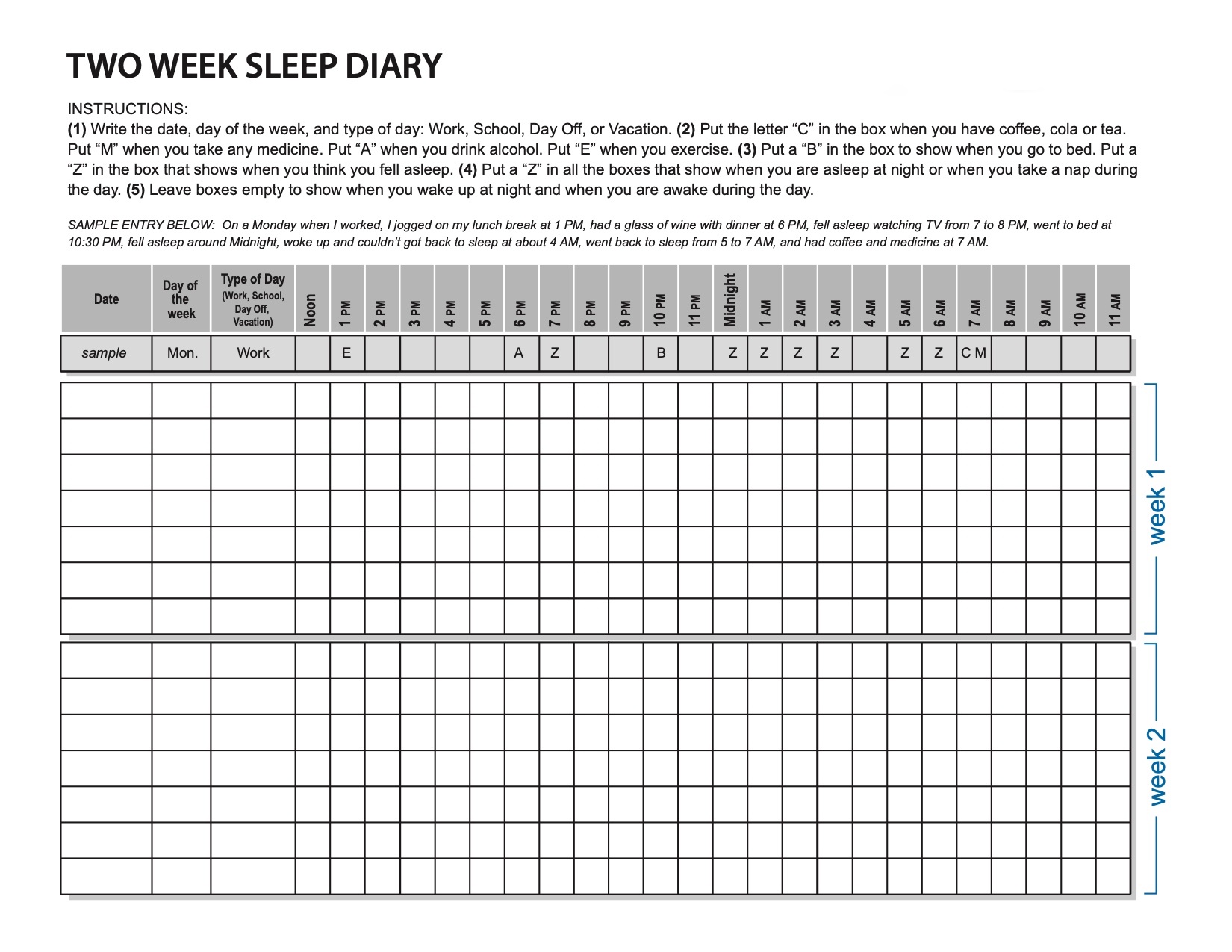
The most honest way to self-assess is to draw your own sleep-diary sheet and fill it in every day. Why bother writing it down? Because insomniacs' memories of their own sleep hide three traps:
- Exaggeration: "I didn't sleep a wink all night" — measure it and you probably got 4–5 hours.
- Missing clues: "I have no idea why I can't sleep" — most likely you forgot that coffee in the afternoon.
- Emotional filter: the more anxiously you recall the night, the worse it seems than it really was.
Keeping a diary is, at its core, swapping vague, colored feeling for plain black-and-white fact.
References
- China Sleep Research Society, et al. China Sleep Big Data Report. 2023.
- Lu Lin (Peking University Sixth Hospital), et al. A review of the status and risk factors of sleep health in China. The Lancet Public Health. 2025.
- Pittsburgh Sleep Quality Index (PSQI) — an internationally used multi-dimensional sleep assessment scale.